

Today students from Liholiho Elementary School visited the Department of Information and Computer Science (ICS) to learn about Computer Science and participate in activities that build their understanding of our field. Students had the opportunity to participate in two different rooms showing them applied uses of Computer Science.
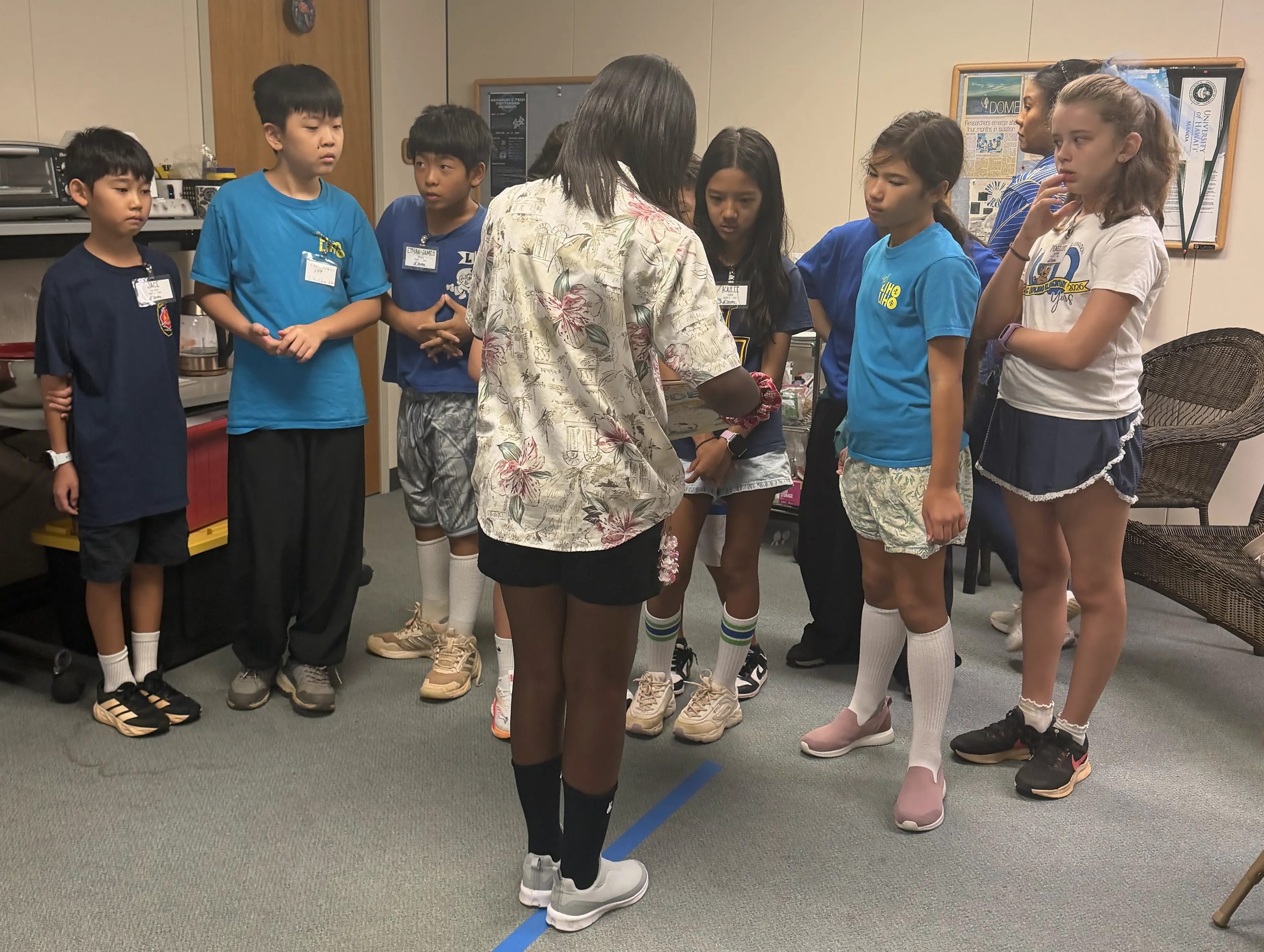
Students and Graduate Assistant Tawanza reading Spaghetti Code while classmates prepare “Hopscotch Algorithm”.
One room was hosted by the Advising Office of ICS led by Faculty Advisor Kenny Ka’aiakamanu-Quibilan, Graduate Assistants Tawanza Farmer and Lukas Moroz, and Peer Advisor Angela Joy Almeron. They walked students through the mission of the Department of ICS, explanations of the Computer Science field, and two games. The first game was SourceScout‘s “AI Detection Quiz“. SourceScout is a tool that allows students to fact check information online and improve their ability to decipher AI generated content. Students walked to the side of the room corresponding to what content they thought was AI and gave explanations for why they thought the content was human-made or AI-made. They took a break afterwards to read excerpts of Spaghetti Code and get a deeper understanding of Computer Science. Afterwards they played the second game which is an activity from How to Explain Coding to a Grown-Up called “Hopscotch Algorithm”. A small group of students wrote the “code” and arranged blocks for hopscotch and the rest of the class followed the instructions simulating what computers do when receiving programming instructions. The session ended with students talking about their new understanding of what it means to be a Computer Scientist and hearing more resources they can use to learn about coding.

The other room was hosted by Dr. Huaijin (George) Chen, Assistant Professor of the Department of ICS and Director of the Computational Imaging and Robotic Perception (CIRP) Lab, and his Graduate Researchers Riki MacMillan and Christian Moore. Students viewed a 10 min presentation explaining robotics and how they can be programmed for control in the real world and simulated environments, and then 2 groups of students rotated between activities. One activity showed students how they can move a robot arm both physically moved and via simulation. The other activity highlighted a humanoid robot by showing students how the robot works and allowing them to see its capabilities ranging from dancing to talking and answering questions. They enjoyed that both activities let them see how programming could be applied to robotics.
By the end of both sessions students were able to get hands-on experience in Computer Science after lots of giggles and excited conversation. We look forward to hosting Liholiho students again in the future and nurturing the interest of future Computer Scientists.